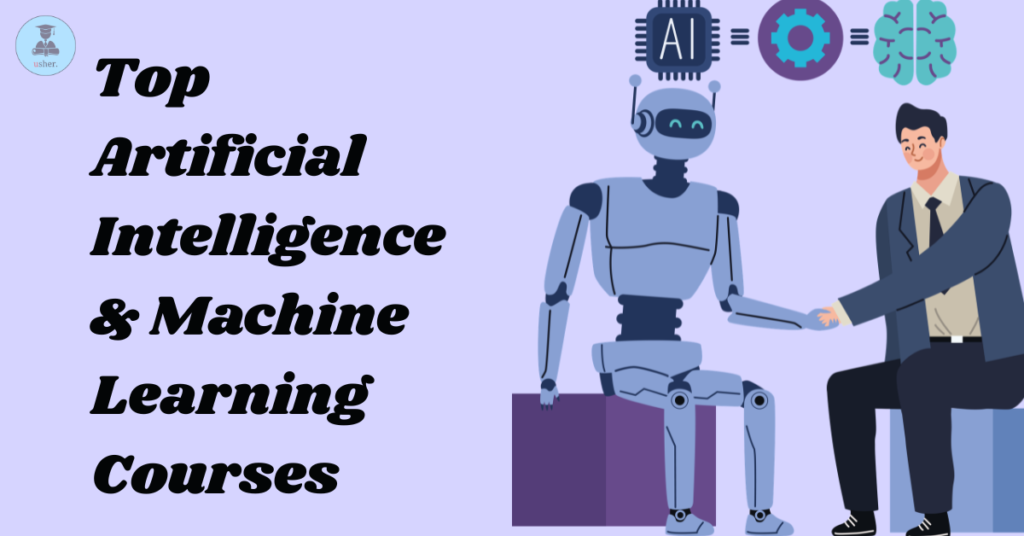
Top Artificial Intelligence &
Machine Learning Courses for Beginners
A 22-year-old ML engineer at a Bangalore product company earns Rs.16 LPA three years out of college. A 28-year-old senior ML engineer with two deep learning projects and one published paper earns Rs.34 LPA. The gap between these two outcomes is not talent. It is preparation, specialisation, and knowing which skills employers are actually paying for right now.
Artificial Intelligence and Machine Learning courses in India range from 4-year B.Tech programmes with AI/ML specialisations at IITs and private universities to standalone certifications from Google, DeepLearning.AI, and Coursera, and 1-year M.Tech programmes at premier institutions. The most employable graduates combine a strong mathematics foundation, hands-on project experience in Python and deep learning frameworks, and at least one publicly verifiable project portfolio. Freshers entering ML engineer roles at product companies start at Rs.8 to 14 LPA; senior ML engineers at 4 to 6 years earn Rs.24 to 40 LPA; AI research scientists at top labs earn Rs.35 to 60 LPA.
What Artificial Intelligence and Machine Learning Actually Covers
Understanding the difference between AI, ML, deep learning, and data science before committing to a course
Artificial Intelligence is the broad field of building systems that perform tasks requiring human-like reasoning. Machine Learning is a subset of AI where systems learn patterns from data rather than being explicitly programmed. Deep Learning is a further subset using neural networks with many layers. Data Science overlaps heavily but focuses more on statistical analysis and business insight extraction than on building deployed AI systems. The distinctions matter for choosing the right courses and targeting the right jobs.
Shreya from Nagpur told everyone she was "doing AI" when she enrolled in a data analytics bootcamp that taught Excel, basic SQL, and introductory Python. Three years later she earns Rs.6 LPA as a junior data analyst and wonders why her IIT Madras batchmate who built a recommendation system from scratch earns Rs.22 LPA in their first ML role. The difference is not that one is smarter than the other. The difference is that one of them understood from the beginning that AI, ML, deep learning, and data analytics are four distinct fields with four different skill requirements, and built deliberately toward the one that actually matched where she wanted to end up.
Artificial Intelligence as an umbrella term covers everything from rule-based expert systems to modern large language models. Within AI, Machine Learning specifically refers to systems that improve through exposure to data, using statistical techniques to identify patterns and make predictions or decisions without being explicitly programmed for each scenario. Deep Learning, a subset of ML, uses multi-layered artificial neural networks that can learn representations directly from raw data, powering breakthroughs in image recognition, natural language processing, and generative AI. Data Science, which frequently gets conflated with AI and ML, is more focused on the statistical analysis, data wrangling, and insight extraction side of the data workflow, producing dashboards and reports rather than deployed intelligent systems.
For students choosing between these related but distinct career paths, the distinction matters enormously in deciding which courses to take and which jobs to target. A data analyst role at a BFSI company requires different skills than an ML engineer role at a product company, which requires different skills than an AI research scientist at a lab. Starting with clarity about which specific career you are building toward, rather than treating all of these as a single unified field, is the single most important planning decision in this space. If you are still weighing whether this field genuinely matches your interests and problem-solving style, this guide on finding your passion and interest is worth reading alongside this one, since the mathematical and programming demands of serious ML work require genuine intrinsic interest to sustain through the required preparation.
Quick Decision Tool
Which AI/ML path is right for you based on your background, goals, and timeline
The right AI/ML entry route depends on your existing programming and mathematics background, whether you want to build AI systems or extract business insights from data, whether you prefer product company work or research, and how much time you have for preparation before your first role. Each path leads to a genuinely different employer type, compensation range, and day-to-day working reality.
Brutal Truth About AI and Machine Learning Careers
What the bootcamp industry, LinkedIn influencers, and university marketing brochures carefully avoid
- The overwhelming majority of "AI jobs" in Indian companies are not building novel AI models. They are applying existing tools, fine-tuning pre-trained models, building pipelines, cleaning data, and maintaining ML infrastructure. This is genuinely valuable and well-compensated work, but students who join the field expecting to design new neural network architectures will find that most industry roles involve much more data engineering and system integration than novel algorithm development.
- Mathematics is not optional in serious ML work, and bootcamps that promise to teach ML without linear algebra, calculus, and probability are producing graduates who can copy-paste code from tutorials but cannot debug a model that is not converging, understand why a feature engineering choice affects model performance, or adapt a published paper's technique to a new problem. This gap becomes visible within 6 to 12 months of employment and is the primary reason many bootcamp graduates plateau at junior analyst roles rather than progressing to senior ML engineering positions.
- The generative AI wave has simultaneously created genuine new opportunities and flooded the entry-level job market with candidates who know how to call an API but cannot explain what is actually happening under the hood. Companies hiring for senior GenAI roles in 2024 and 2025 are distinguishing sharply between engineers who understand transformer architecture, embedding models, and RAG systems at a technical level, and those who have just worked through a few LangChain tutorials. The former are scarce and well-compensated; the latter are plentiful and competing for the same limited number of junior roles.
- Kaggle competition rankings and GitHub repositories matter in ML hiring in a way that has no direct equivalent in most other engineering fields. Senior ML engineers and data scientists at top companies frequently review candidate GitHub profiles and Kaggle histories before shortlisting, because demonstrable public work provides evidence of actual skill that a resume and certificate list cannot. Students who build no public project portfolio during their preparation period are systematically less competitive than those who do, even when the underlying skill level is comparable.
- The AI/ML job market in India is bifurcated in a way that is not immediately visible from the outside. The top 10 to 15 percent of roles, at product companies, research labs, and global capability centres of major technology companies, pay Rs.16 to 40 LPA at entry for strong IIT or IISc graduates with serious project experience. The remaining 85 to 90 percent of roles, at IT services companies and smaller firms, pay Rs.5 to 10 LPA for the same degree from a less prestigious institution, for work that often involves less challenging and less technically current tasks. The prestige of the institution and the quality of the project portfolio determine which of these two markets a graduate enters, to a degree that is more extreme than in most other technology careers.
All AI and ML Courses at a Glance
Every major degree, certification, and specialisation route
AI and ML education in India spans formal engineering degrees with AI specialisations, research-oriented M.Tech and PhD programmes, industry-focused online certifications from Google and DeepLearning.AI, and short-term bootcamps. The combinations that produce genuinely employable graduates are a strong technical foundation plus demonstrated project work, regardless of whether the foundation comes from a degree or intensive self-study.
Two students apply for the same ML engineer role at a Bangalore product company. The first has a B.Tech CSE from a tier-2 college, a DeepLearning.AI specialisation, and two deployed ML projects: a fraud detection model connected to a live demo API and a fine-tuned LLM for legal document summarisation, both on GitHub with clean documentation. The second has a B.Tech CSE from the same tier-2 college and a certificate list that includes six online courses, none deployed as working applications. The first student gets the interview. The second wonders why certifications are not enough.
B.Tech CSE (AI/ML Specialisation)
A 4-year engineering degree with dedicated AI/ML coursework, offered at IITs, NITs, IIIT Hyderabad, and an increasing number of private universities. Provides the most rigorous technical foundation, including the mathematics, algorithms, and programming depth that senior ML roles require. The best starting point for students who have four years before needing employment and want access to the top tier of the ML job market.
M.Tech AI / ML / Data Science
A 2-year specialisation after a B.Tech in CSE or related discipline, accessed through GATE. IIT Hyderabad, IIT Bombay, IIT Madras, IISc, and IIIT Hyderabad offer the most respected programmes. Opens research scientist tracks, senior engineering roles at product companies, and significantly higher entry compensation compared to B.Tech alone. The realistic path for B.Tech graduates from tier-2 or tier-3 colleges wanting to break into the top-tier ML job market.
DeepLearning.AI Specialisations (Coursera)
Andrew Ng's Machine Learning Specialisation and Deep Learning Specialisation are the most widely respected online ML certifications globally, used by working engineers for upskilling as much as by students for initial learning. The Mathematical Foundation for Machine Learning and MLOps Specialisations extend the coverage to production deployment. These certifications, combined with project work, have genuinely replaced degree requirements at many companies for candidates who demonstrate practical skill alongside the credential.
fast.ai Practical Deep Learning for Coders
Jeremy Howard's deliberately bottom-up practical course starts with working models and progressively explains theory, producing engineers who can build before they can fully explain every mathematical detail. Used heavily by Kaggle competitors and practising engineers. Free, entirely online, and consistently produces more practically capable graduates than many expensive bootcamps. Best combined with more theory-focused material like the DeepLearning.AI specialisations for a complete foundation.
Google Data Analytics / IBM Data Science Certificate
Professional certificate programmes on Coursera covering the full data science workflow from data cleaning through visualisation and basic ML model building. A realistic entry point for non-CS backgrounds entering the data science job market. Less technically rigorous than the DeepLearning.AI specialisations but produces graduates who are immediately functional in analytics roles at BFSI and e-commerce companies. The Google certificate specifically has strong employer recognition among Indian IT services companies.
AWS ML Specialty / Google Professional ML Engineer
Cloud provider-specific machine learning certifications covering model deployment, pipelines, monitoring, and the full ML operations stack on cloud infrastructure. As Indian companies increasingly deploy AI systems on cloud platforms, ML engineers who can bridge pure ML modelling skills with cloud deployment and MLOps practices command a significant salary premium. One of the most financially valuable credential combinations in the current Indian ML job market.
PhD in AI / Machine Learning
Required for research scientist roles at Google DeepMind India, Microsoft Research India, Amazon Science, and Indian academic institutions. Typically 4 to 5 years after an M.Tech, involving publishable original research. Research scientists at top global AI labs in India earn Rs.35 to 65 LPA at entry. A deeply rewarding career track for students genuinely drawn to fundamental research, but not the right path for those primarily motivated by faster financial returns.
AI/ML Bootcamps (6 to 12 Months)
Intensive, structured programmes offered by providers including Scaler Academy, UpGrad, Great Learning, and Coding Ninjas. Vary significantly in quality, curriculum depth, and placement support. The best bootcamps produce placement-ready graduates for junior data scientist and analyst roles at IT services companies, with placement in the Rs.6 to 10 LPA range. Students should evaluate any bootcamp by the technical depth of its curriculum, the quality of its placement partners, and verified alumni outcomes before enrolling.
All Courses: Quick Comparison
Every programme side by side in one scrollable table
| Course / Programme | Duration | Prerequisite | Best Track | Starting Salary | Best For |
|---|---|---|---|---|---|
| B.Tech CSE (AI/ML Spec) | 4 yrs | 10+2 PCM, JEE | ML Engineering / Research | Rs.16–28 LPA (IIT/IIIT) | Best long-term foundation |
| M.Tech AI / ML / DS | 2 yrs | B.Tech + GATE | ML Engineering / Research | Rs.14–30 LPA | Top-tier market access from tier-2 B.Tech |
| DeepLearning.AI Specialisation | 3–6 months | Basic Python | ML Engineering / GenAI | Rs.8–14 LPA (with projects) | Best self-study credential globally |
| fast.ai Practical Deep Learning | 8–12 weeks | Python knowledge | Practical DL / Kaggle | Skill supplement | Hands-on DL ability, free |
| Google / IBM Data Science Cert | 4–6 months | None | Data Analytics | Rs.4.5–8 LPA | Non-CS background entry |
| AWS ML / Google ML Engineer Cert | 2–4 months | ML + Cloud exp | MLOps / Cloud AI | Rs.14–26 LPA | Production deployment premium |
| PhD in AI / ML | 4–5 yrs after M.Tech | M.Tech + publications | Research Science | Rs.35–65 LPA | Lab research, academic roles |
| AI/ML Bootcamp | 6–12 months | Basic programming | Data Science entry | Rs.5–10 LPA | Fast workforce entry, verify quality first |
The AI and ML Skill Ladder
What skills, tools, and knowledge you need at each stage of this career
AI and ML skills are not a simple checklist. They form a genuine dependency hierarchy: Python and mathematics are foundational, classical ML comes next, deep learning builds on that, and production deployment and specialised architecture work come last. Attempting to learn deep learning without a solid Python and mathematics base produces graduates who can run notebooks but cannot diagnose or fix problems when models fail in production.
The AI/ML Skill Ladder by Stage and Track
Deep Dive by Specialisation
What each AI and ML career track actually looks like from the inside
AI and ML careers branch into ML engineering (building production systems), data science (extracting insights), research science (advancing the field), generative AI engineering (building with LLMs and foundation models), and computer vision or NLP specialisations. Each track has a different employer landscape, day-to-day workflow, and compensation trajectory. Choosing the wrong track for your actual interests and strengths is the most common cause of stagnation at junior levels.
A research scientist at Microsoft Research India in Bangalore and an ML engineer at Swiggy both have "machine learning" in their job descriptions. The research scientist spends their days reading arxiv papers, running long experiments on GPU clusters, writing Python code, and writing papers. The ML engineer spends their days in code reviews, debugging data pipelines, A/B testing model changes, and arguing with product managers about model latency requirements. Both are intellectually demanding and financially rewarding careers. They require fundamentally different personalities, different daily habits, and different definitions of what constitutes satisfying work.
Machine Learning Engineering
ML engineering is the discipline of taking machine learning models from research or experimentation into robust, scalable production systems. An ML engineer builds the infrastructure to train models on large datasets, deploys models as APIs or microservices, monitors production model performance, and continuously improves model quality based on real-world feedback. This role is closer to software engineering than to data science, and strong software engineering fundamentals, including system design, distributed systems, and production coding practices, are as important as the ML knowledge itself.
The employer landscape for ML engineers in India concentrates heavily in Bangalore and Hyderabad, across product companies including Flipkart, Swiggy, Zomato, Ola, and PhonePe, global technology companies including Google, Amazon, Microsoft, and Meta with large India offices, and a substantial ecosystem of funded AI-native startups. A strong ML engineer from an IIT or IIIT with meaningful project experience enters these companies at Rs.16 to 24 LPA. Mid-level ML engineers with 3 to 5 years of production experience and specialisation in recommendation systems, search ranking, or real-time inference earn Rs.28 to 42 LPA.
MLOps, the practice of managing the full lifecycle of ML models in production, including data versioning, experiment tracking, model registry, and deployment orchestration, has emerged as a high-value sub-specialisation within ML engineering. Engineers who combine ML modelling skills with strong MLOps capabilities using tools like MLflow, Kubeflow, and AWS SageMaker are consistently among the best-compensated ML practitioners at equivalent experience levels, because this combination of skills remains scarcer than either pure ML or pure DevOps knowledge individually.
Data Science and Analytics
Data science in the Indian industry context is a broad and somewhat variable title covering roles that range from genuinely sophisticated statistical modelling and ML work to essentially advanced data analytics with some Python. The most common interpretation at most large Indian companies involves extracting business insights from structured data, building predictive models for business decisions, and communicating findings to non-technical stakeholders. This is distinct from ML engineering in that it focuses more on the insight and less on the deployed system.
The BFSI sector is the largest employer of data scientists in India, using predictive modelling for credit risk scoring, fraud detection, and customer churn prediction at companies including HDFC Bank, ICICI Bank, Axis Bank, Bajaj Finance, and a large ecosystem of NBFCs and fintech companies. E-commerce companies, telecom operators, and large manufacturing companies also run substantial data science teams. A data scientist at a mid-tier BFSI company with two years of experience earns Rs.8 to 14 LPA. Senior data scientists with domain expertise in credit risk or fraud modelling earn Rs.18 to 28 LPA at the same type of employer.
The distinction between a data scientist and a data analyst is technically about the sophistication of the modelling work, but in practice many companies use these titles inconsistently, which makes evaluating roles by their actual technical requirements more reliable than by job title alone. When assessing a data science role, candidates should specifically ask about the tech stack (Python with scikit-learn and PyTorch is genuinely different from Excel and Tableau), whether models are deployed to production or only used for internal reporting, and the split between data wrangling, modelling, and presentation work in a typical week.
Generative AI Engineering
Generative AI engineering is the newest and currently fastest-growing specialisation in the field, covering the building of applications and systems on top of large language models, diffusion models, and other foundation models that generate text, images, code, and other media. A GenAI engineer works with LLM APIs, builds RAG (Retrieval Augmented Generation) systems to give models access to company-specific knowledge, fine-tunes foundation models for specific use cases, and designs prompt engineering systems that reliably produce desired outputs.
The Indian market for GenAI engineers is growing rapidly across multiple employer types: IT services companies building GenAI solutions for enterprise clients (Infosys, TCS, and Wipro have all made significant investments in GenAI practices), funded Indian AI-native startups, and global product companies with India GCCs building internal AI tools. An engineer with one to two years of GenAI-specific experience including deployed RAG applications and fine-tuning experience earns Rs.12 to 22 LPA, substantially more than a similarly experienced generalist ML engineer in many cases, reflecting the genuine scarcity of practitioners with hands-on production GenAI experience.
The critical distinction employers are making in GenAI hiring in 2024 and 2025 is between engineers who understand what is actually happening in transformer-based models at a technical level, and those who can only use API wrappers without deeper understanding. Engineers who can explain attention mechanisms, understand why RAG improves grounding, and diagnose hallucination causes are significantly more hireable and better-compensated than those who have only learned to chain LLM calls together through frameworks. The underlying deep learning foundation matters, even in this relatively applied layer of the AI stack.
AI Research Science
AI research science is the track concerned with advancing the fundamental capabilities of AI systems, publishing novel findings, and contributing to the field's knowledge base. Research scientists at industrial labs including Google DeepMind India, Microsoft Research India, Amazon Science, and Flipkart AI Labs work on problems ranging from improving large language model reasoning to advancing computer vision architectures, typically with full academic freedom to publish their findings.
Entry into industrial research science roles in India requires exceptional academic credentials, typically a PhD from a top institution with publications in top-tier conferences including NeurIPS, ICML, ICLR, CVPR, or ACL, plus demonstrable ability to work on problems at the frontier of the field. The compensation reflects this selectivity: research scientists at Google DeepMind India or Microsoft Research India enter at Rs.35 to 55 LPA, with principal research scientist roles reaching Rs.60 to 90 LPA, making these among the highest-compensated technical roles available in the Indian job market across any field.
Academic research positions at IIT and IISc faculty level require similar credentials to industrial research scientist roles, with assistant professor positions typically at Rs.12 to 18 LPA by government pay scale, significantly below their industrial research counterparts but with the distinct appeal of academic freedom, student mentorship, and the ability to pursue a broader research agenda without direct product delivery pressure. Many IIT and IISc faculty members supplement their academic salaries with consulting arrangements and startup advisory roles, which can substantially increase their total compensation.
Computer Vision and Natural Language Processing
Computer Vision (CV) and Natural Language Processing (NLP) are the two most mature specialised application domains within AI and ML, each with distinct toolchains, research communities, and employer ecosystems. CV engineers work on systems that process and understand images and video, from object detection in autonomous vehicle systems to quality inspection in manufacturing, medical image analysis, and retail analytics. NLP engineers build systems that process and understand human language, from sentiment analysis and machine translation to conversational AI and document understanding.
For CV specifically, India's automotive sector, including companies with autonomous driving programmes, and the manufacturing sector using machine vision for quality inspection are significant employer bases alongside the standard technology company landscape. Bosch India, Ola Electric, and several automotive electronics companies employ CV engineers for specific embedded and real-time applications. A CV engineer with three years of experience and specialisation in object detection or medical imaging earns Rs.14 to 22 LPA.
NLP has been substantially transformed by the large language model wave, with the distinction between traditional NLP engineering and GenAI engineering becoming increasingly blurred. Engineers who built their skills on classical NLP techniques, including named entity recognition, dependency parsing, and sequence labelling with libraries like spaCy and NLTK, are finding that the market increasingly prefers or requires transformer-based LLM approaches for the same tasks. NLP engineers who have successfully transitioned their skills into the transformer and LLM era are among the most well-compensated practitioners in the field, with senior NLP engineers at product companies earning Rs.20 to 35 LPA.
Fresher vs Senior Salary Comparison
What you earn when you start versus what the same track pays at 5 to 8 years of experience
AI and ML salary growth from entry to senior level is among the steepest in Indian technology, driven by genuine scarcity of experienced practitioners at every level above entry. The gap between a fresh graduate and a senior ML engineer with 5 years of production experience is larger in this field than in almost any other Indian technology career, reflecting how much accumulated hands-on experience matters in work that is fundamentally about building better models and systems over time.
Fresher Salaries (0–2 Years)
- ML Engineer (IIT/IIIT, product co.): Rs.16–24 LPA
- ML Engineer (tier-2 college, IT services): Rs.6–10 LPA
- Data Scientist (BFSI / e-commerce): Rs.7–12 LPA
- Data Analyst (entry level): Rs.4–7 LPA
- GenAI Engineer (with projects): Rs.10–16 LPA
- Research Scientist (PhD, top lab): Rs.35–55 LPA
Senior Salaries (5–8 Years)
- Senior ML Engineer (product co.): Rs.28–45 LPA
- Staff ML Engineer / ML Lead: Rs.40–65 LPA
- Senior Data Scientist (BFSI): Rs.20–32 LPA
- Senior GenAI / LLM Engineer: Rs.24–40 LPA
- Principal Research Scientist: Rs.55–90 LPA
- Head of AI / Chief AI Officer: Rs.60–120 LPA
Myth vs Reality in AI and ML Careers
The misconceptions that lead students to build the wrong skills for the wrong jobs
You can learn enough AI and ML to get a good job in 3 months without knowing mathematics.
Entry-level data analyst roles are accessible in 3 to 6 months of focused study. Genuine ML engineering roles at product companies require linear algebra, probability, calculus, and statistics, plus programming fluency, plus project experience, built over 12 to 24 months of serious preparation. Bootcamps that promise otherwise produce graduates who plateau at junior analyst levels and cannot progress to ML engineering roles.
AI and ML jobs are only available at technology companies and startups.
Banking, financial services, healthcare, manufacturing, agriculture, and government are all significant and growing employers of AI/ML talent in India. HDFC Bank's data science team is one of the largest in the country. ONGC, Tata Steel, and several large manufacturers use ML for predictive maintenance. The sector diversity of genuine ML employment is substantially broader than the technology company dominated image the field projects.
Getting a certificate from Coursera or an online bootcamp is enough to land an ML engineer role.
Certifications are a signal of commitment, not proof of ability. ML engineer hiring at product companies uses technical interviews that require solving real ML problems under time pressure, explaining model choices, and demonstrating system design thinking. Candidates without deployed project portfolios and strong fundamentals fail these interviews regardless of certificate count. The certificate plus the project portfolio together create a competitive application.
Generative AI has made traditional ML engineering skills obsolete.
Traditional ML skills remain foundational for understanding why GenAI systems behave as they do, building the data pipelines that feed them, and deploying them at production scale. Companies building GenAI applications still need engineers who understand model evaluation, data quality, and production system design. The overlap between traditional ML and GenAI engineering is substantial, not a replacement relationship.
AI will replace software engineers and ML engineers themselves within a few years.
AI is changing software engineering workflows and automating certain repetitive tasks, but the demand for engineers who understand AI systems, can evaluate their outputs, and can design reliable AI-integrated products is growing faster than the automation is reducing it. The engineers who combine AI skills with traditional software engineering depth are among the most valued practitioners in the current market, not the most vulnerable to displacement.
Data science and machine learning are essentially the same career.
Data science at most Indian companies involves statistical analysis, business reporting, and predictive modelling for internal use. ML engineering involves building production systems that serve predictions to end users at scale, with engineering-grade reliability requirements. Both are valid and well-compensated careers, but they require different skills, attract different types of people, and lead to different career ceilings and trajectories.
Real Case Studies
Three practitioners, three entry points, three different outcomes from the same field
The AI and ML practitioners who build the strongest careers are not necessarily the ones who started with the best academic pedigree. They are the ones who understood which specific problem they wanted to solve, built the exact skills that problem requires, and created public evidence of those skills before they needed to prove them in an interview room. In a field where the gap between demonstrated capability and claimed capability is easier to expose than almost anywhere else in engineering, what you have actually built matters more than what you have studied.
Rohan completed B.Tech CSE at IIT Kharagpur in 2018, choosing electives deliberately toward machine learning, linear algebra, and probability from his second year after attending a guest lecture by a Flipkart ML engineer in 2016 that described the scale of the recommendation system problem. He started his first Kaggle competition in his second year, not to win but specifically to build the habit of working on real datasets with real evaluation metrics rather than textbook exercises.
By his final year, he had a Top 200 Kaggle rank in a tabular data competition, a GitHub repository with three end-to-end ML projects including a movie recommendation system and a sentiment analysis pipeline for Indian language text, both deployed on free-tier cloud infrastructure with working demo URLs. His internship at a small ML startup in Bangalore in his third year had given him his first real experience with production model serving and A/B testing framework basics.
Flipkart's ML team recruited him directly from IIT Kharagpur at Rs.22 LPA in 2018, one of the highest offers in his batch, placing him on the search ranking team working on learning-to-rank models for product search. He worked specifically on the offline evaluation framework for search quality improvements in his first two years, building the deep systems understanding that would later set him apart from peers who only worked on model experimentation. A promotion to Senior ML Engineer in 2022 at Rs.38 LPA came after he led a ranking model refactor that measurably improved search conversion, with a direct business impact his team could demonstrate in A/B test results.
Ananya completed B.Sc Mathematics and Computing from Delhi University in 2019, a programme that gave her strong linear algebra and probability foundations but almost no exposure to practical machine learning or modern Python data science tools. Her first job was as a junior analyst at a Delhi-based insurance company, earning Rs.4.8 LPA, working in Excel and basic SQL to produce monthly risk reports.
She started Andrew Ng's Machine Learning Specialisation on Coursera in January 2020, spending three hours every evening after work, completing all three courses in four months while continuing to work full time. She then moved directly into the Deep Learning Specialisation, which she finished in August 2020. Rather than continuing to add certificates, she made a deliberate decision to stop studying and start building, spending the next five months building two end-to-end projects: a credit card fraud detection system using real Kaggle data, deployed as a FastAPI application with model monitoring, and a document classification system for insurance claim categorisation that reflected her actual domain knowledge from her analyst role.
She applied to 22 companies in January 2021 with these two projects as her primary credential, alongside her certificates. Razorpay's ML team shortlisted her specifically because her fraud detection project was directly relevant to their risk team's work, and her deployed application demonstrated real engineering discipline, not just notebook-level experimentation. She joined Razorpay's fraud ML team in March 2021 at Rs.12 LPA, the first role of her career with ML engineer in the title. A promotion in 2023 and a pay revision in 2024 brought her to Rs.24 LPA as she developed specialisation in real-time fraud scoring systems, one of the most technically demanding and well-compensated areas in Indian fintech ML.
Varun completed B.Tech Electrical Engineering at NIT Trichy in 2016, a programme that gave him solid mathematics and signal processing foundations but limited exposure to modern ML. His final year project on deep learning for speech recognition, built entirely through self-study using early TensorFlow documentation and research papers he found through Google Scholar, confirmed both his interest and his aptitude for research-oriented ML work.
He secured admission to IIT Bombay's M.Tech programme in Computer Science and Engineering with an AI specialisation through GATE in 2016, joining specifically because of the research group working on NLP, which aligned with his thesis interest in multilingual NLP for Indian languages. His M.Tech thesis, on low-resource machine translation for Indian language pairs, was published at ACL 2018, his first conference publication at a top-tier venue. The publication was the key credential that distinguished him from other M.Tech graduates in research-focused hiring rounds.
Microsoft Research India offered him a Research Fellow position in 2018, a transitional role between graduate student and full research scientist that allowed him to work on research problems while building toward a PhD. He enrolled in a part-time PhD programme in 2019, publishing two more papers at EMNLP 2020 and NAACL 2021 on multilingual representation learning before being converted to a full Research Scientist position at Rs.38 LPA in 2021. A promotion in 2023 brought him to Rs.48 LPA, where he now leads a research agenda on efficient language models for low-resource languages, an area of genuine strategic importance to Microsoft's global language model investments.
Career Spotlight
Nine real roles that AI and ML professionals actually fill in India
Machine Learning Engineer
Builds, deploys, and maintains ML models in production systems. Product companies including Flipkart, Swiggy, Razorpay, and PhonePe are top employers. Requires strong software engineering skills alongside ML expertise.
Data Scientist (BFSI / E-commerce)
Builds predictive models for business decisions including credit risk, churn, and fraud. HDFC Bank, ICICI Bank, Bajaj Finance, and large e-commerce companies are the largest employers in India for this role.
Generative AI / LLM Engineer
Builds applications using LLMs including RAG systems, copilots, and AI agents. The fastest-growing specialisation by job posting volume in 2024. Demand from IT services, product companies, and AI-native startups.
Research Scientist (AI Lab)
Publishes novel AI research. Google DeepMind India, Microsoft Research India, Amazon Science, and IIT/IISc labs are primary employers. Requires PhD with top-tier conference publications.
MLOps Engineer
Manages ML model lifecycle in production including training pipelines, model registry, monitoring, and deployment orchestration. Scarcest combination in the market. Strong salary premium at all experience levels.
Computer Vision Engineer
Builds image and video understanding systems. Automotive, manufacturing, healthcare, and retail analytics are key sectors. Bosch, Ola Electric, and AI-health startups like Niramai are notable employers.
NLP Engineer
Builds language understanding systems for chatbots, document processing, and multilingual applications. Particularly valuable at Indian companies needing regional language AI capabilities.
AI Product Manager
Manages AI product development, translating business requirements into model specifications and working with ML teams to ship AI features. Requires both product thinking and ML literacy, a rare and well-compensated combination.
Data Engineer
Builds and maintains the data infrastructure that ML models run on. SQL, Spark, Kafka, and cloud data platforms are core tools. Every company with ML also needs data engineers, making this one of the most consistently hired roles.
Path Comparison Matrix
Every AI/ML career track rated on entry difficulty, salary ceiling, and job availability
| Career Track | Entry Salary | 5yr Salary | Job Volume | Salary Growth | Entry Difficulty |
|---|---|---|---|---|---|
| ML Engineering (Product Co.) | Rs.16–24 LPA | Rs.32–48 LPA | ★★★★☆ | ★★★★★ | Very High |
| Generative AI / LLM Engineering | Rs.12–20 LPA | Rs.28–42 LPA | ★★★★★ | ★★★★★ | High |
| MLOps Engineering | Rs.14–22 LPA | Rs.28–40 LPA | ★★★☆☆ | ★★★★★ | High |
| Data Science (BFSI / E-com) | Rs.8–14 LPA | Rs.20–32 LPA | ★★★★★ | ★★★★☆ | Medium |
| Computer Vision / NLP | Rs.12–18 LPA | Rs.22–36 LPA | ★★★★☆ | ★★★★★ | High |
| AI Research Science (Industrial) | Rs.38–55 LPA | Rs.60–90 LPA | ★☆☆☆☆ | ★★★★★ | Extreme |
| Data Engineering | Rs.8–14 LPA | Rs.20–30 LPA | ★★★★★ | ★★★★☆ | Medium |
| Data Analysis (Entry Level) | Rs.4–7 LPA | Rs.10–18 LPA | ★★★★★ | ★★★☆☆ | Low |
Salary Overview by Role
Mid-career figures for professionals with 6 to 9 years of experience
Top Colleges and Institutes for AI and ML in India
Where the degree, the research culture, and the placement pipeline all matter
IITs and IISc dominate the top tier of AI/ML education in India for both undergraduate and postgraduate programmes, with IIIT Hyderabad being the most prominent specialised institute for AI and ML research specifically. The college choice has a more direct impact on initial placement quality in AI/ML than in most other engineering fields, because the top product company ML teams recruit heavily from a small number of preferred institutions.
IIT Hyderabad
India's strongest M.Tech AI programme among the IITs, with a dedicated Department of Artificial Intelligence that is one of the first of its kind in the country. Strong industry connections with Hyderabad's large technology company ecosystem and excellent research publication record in top-tier ML conferences.
Visit WebsiteIndian Institute of Science (IISc)
The pre-eminent destination for AI/ML research in India, with deep ties to Google DeepMind India, Microsoft Research India, and other major AI labs. IISc graduates in ML research have the strongest PhD-track credentials of any institution in the country, and IISc MTech graduates consistently receive some of the highest ML-specific offers in the country.
Visit WebsiteIIIT Hyderabad
The most specialised and research-focused AI/ML institution in India outside the IIT/IISc system. IIIT Hyderabad's Language Technologies Research Centre and Centre for Visual Information Technology have produced foundational research in Indian language NLP and computer vision. Consistently high placement into top-tier product company ML teams.
Visit WebsiteIIT Bombay
Strong B.Tech CSE and M.Tech AI/ML programmes with excellent research depth in computer vision and NLP. Location advantage for Mumbai's substantial BFSI data science market alongside the standard product company placement. Strong industry research partnerships with global technology companies.
Visit WebsiteIIT Madras
Strong AI/ML research environment with notable contributions to speech technology and healthcare AI. IIT Madras's Robert Bosch Centre for Data Science and AI is a significant research hub. Placement into global technology companies and strong alumni network across Bangalore's ML industry.
Visit WebsiteAmrita Vishwa Vidyapeetham (AIMS)
One of India's stronger private university AI/ML programmes, with specific strength in applied healthcare AI and a growing research publication record. A reasonable option for students who cannot access the IIT/IIIT/IISc tier but want a dedicated AI/ML programme with genuine research infrastructure rather than a generic CSE degree with minimal AI content.
Visit WebsiteManipal Institute of Technology
A well-resourced private institution with dedicated AI/ML elective tracks within its CSE programme and a reasonable industry placement record. Strong option for students in the JEE Main range who want a structured engineering degree with AI elective depth and good placement support for IT services and analytics roles.
Visit WebsiteCoursera / DeepLearning.AI (Online)
Andrew Ng's DeepLearning.AI specialisations on Coursera represent the most globally recognised online ML education credentials. Not a college replacement, but the most credible online supplement to any formal degree or the strongest self-study foundation for non-CS graduates transitioning into ML roles. Verifiable by employers and consistently mentioned in successful career-transition stories.
Visit WebsiteLearning Path and Resources
The exact sequence to follow from absolute beginner to job-ready ML professional
The most reliable learning path to an ML engineering role combines mathematics fundamentals, Python programming, classical ML with scikit-learn, deep learning with PyTorch, at least one specialisation track, and two deployed end-to-end projects on GitHub. The sequence matters as much as the content. Skipping the mathematics and classical ML foundation to jump directly to deep learning produces engineers who can run code but cannot understand or improve it.
| Stage | What to Learn | Best Free Resource | Timeline | Output to Build |
|---|---|---|---|---|
| 1 — Foundation | Python, NumPy, pandas, linear algebra, probability | CS50P (Harvard), 3Blue1Brown Linear Algebra series | 2–3 months | Python data analysis of a real dataset |
| 2 — Classical ML | Regression, classification, clustering, model evaluation | Andrew Ng ML Specialisation (Coursera, auditable free) | 2–3 months | Kaggle competition submission (any tabular dataset) |
| 3 — Deep Learning | Neural networks, CNNs, RNNs, transformers | DeepLearning.AI Deep Learning Specialisation + fast.ai | 3–4 months | Image classifier or text classifier deployed as API |
| 4 — Specialisation | Choose: NLP/LLMs, Computer Vision, MLOps, or Data Engineering | HuggingFace NLP course, fast.ai CV, MLflow docs | 2–3 months | End-to-end project in chosen specialisation, deployed publicly |
| 5 — Portfolio | Two complete end-to-end projects, clean GitHub, documented README | Kaggle, Papers With Code, HuggingFace Spaces | 2–3 months | Two live project demos with code and write-ups |
| 6 — Interview Prep | ML system design, statistics review, coding practice | Chip Huyen's ML Interviews book, LeetCode Easy/Medium | 1–2 months | Mock interview readiness, internship or first role applications |
- Start with the mathematics before any ML course, not alongside it. Students who try to learn ML while also learning linear algebra for the first time frequently find that confusion in both areas leads to shallow understanding of each. Three weeks on 3Blue1Brown's Essence of Linear Algebra series and Khan Academy's Probability and Statistics will pay dividends throughout every subsequent stage.
- Learn Python for data science specifically, not general-purpose Python. Focus your first 4 to 6 weeks on NumPy, pandas, matplotlib, and basic statistics in Python, applied to real datasets you can download from Kaggle or UCI Machine Learning Repository. Data wrangling and visualisation skills are as important as modelling skills in most ML roles.
- Build every project to the point of deployment, not just a Jupyter notebook. A notebook is a learning artefact. A deployed FastAPI application with a README, a requirements file, and a live demo URL is a portfolio artefact. The latter is what interviewers actually evaluate, and building to deployment forces you to solve the engineering problems that notebooks conveniently avoid.
- Join the Kaggle community actively: read top solution write-ups after competitions close, participate in discussion forums, and submit to at least two competitions before applying for roles. The pattern recognition you build from reading how experts approach problems is irreplaceable by any amount of course-following.
- Read at least two research papers per month in your specialisation area. Papers With Code (paperswithcode.com) surfaces the most impactful recent papers with linked implementations. The ability to read and implement papers is a differentiator in research-adjacent ML roles and in senior ML engineering interviews alike.
- Build in public. Write about what you are learning on LinkedIn or a personal blog. Indian ML practitioners who document their learning journey publicly consistently report faster job search outcomes, because the documentation itself demonstrates commitment, communication skill, and technical depth simultaneously.
The self-directed learning required for AI and ML preparation demands exceptional consistency over 12 to 24 months. This guide on building effective study habits and this resource on time management strategies for students are both directly applicable to the sustained effort this preparation requires. Managing the psychological challenges of a long self-directed preparation period, particularly the months before the first real interview call arrives, is worth addressing directly; this piece on developing a growth mindset provides a useful frame. For students weighing AI and ML against other technology careers, this guide on planning your career from school provides structured decision-making tools. The memorisation-heavy preparation for mathematics and statistics fundamentals is also meaningfully supported by this resource on effective memorisation techniques. When the time comes to apply and interview, this guide on succeeding in placements addresses the specific challenges of ML-focused technical interviews and portfolio presentation.
Frequently Asked Questions
The real questions students and career-changers ask about AI and ML, answered directly
Ready to Build Your AI and ML Career?
AI and ML offer some of the highest salary trajectories in Indian technology, a genuine shortage of qualified practitioners at every level above entry, and the intellectual challenge of working on problems that are genuinely difficult and consequential. The students who succeed here are not necessarily the ones who started at IITs. They are the ones who built a real mathematics foundation, chose a specific track rather than trying to learn everything at once, and created public evidence of their skills before the first interview. Use the Skill Ladder and the Learning Path above to start from exactly where you are, and begin building your portfolio today.