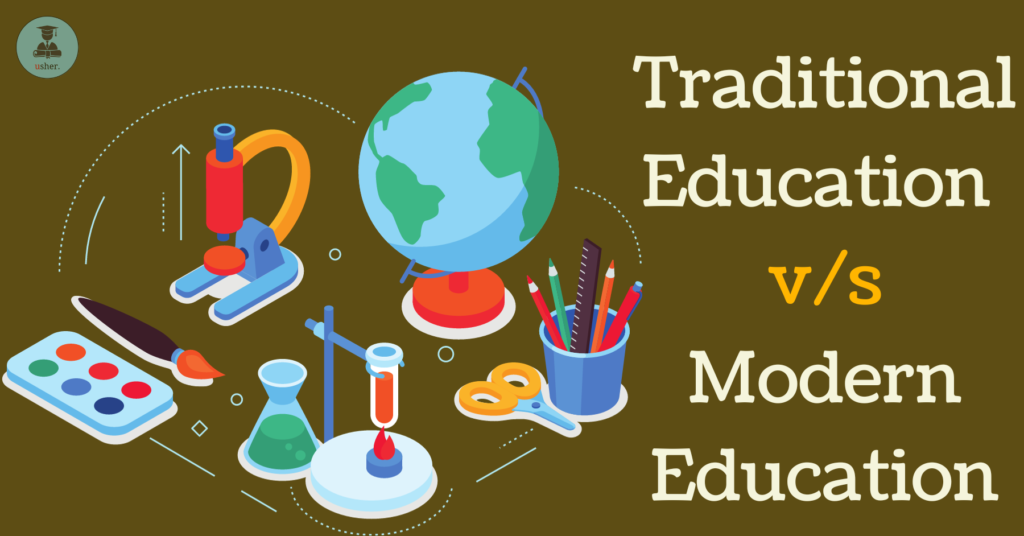
Quick answer: Traditional education is teacher-centred and built on classrooms, textbooks, lectures, and exams. Modern education is student-centred and built on technology, projects, and skills. Neither is fully better. For most students in India today, a blended model that keeps strong fundamentals and discipline while adding technology and critical thinking works best.
Choosing between traditional education vs modern education is one of the most common debates in Indian households today. Parents who grew up with blackboards, textbooks, and strict classrooms now watch their children learn through tablets, smart classes, and online courses. So which approach is better, modern education vs traditional education, and what does each really mean for a student in India?
This guide breaks down both systems in plain language. You will find clear definitions, a side by side comparison, the real advantages and disadvantages of each, and an honest verdict on which one works best in 2026. Whether you are a student deciding how to study, a parent planning your child’s path, or an educator rethinking your methods, the goal is simple. Help you make a confident, informed choice instead of following the crowd.
What Is Traditional Education?
Traditional education is the conventional, teacher-centred system most of us grew up with. Learning happens in a physical classroom, led by a teacher who explains the lesson while students listen, take notes, and memorise. Knowledge flows mainly in one direction, from teacher to student.
The core features of traditional education are easy to recognise: a fixed timetable and syllabus, textbooks and a blackboard or whiteboard, rote learning and repetition, regular written exams that decide a student’s grade, and a strong emphasis on discipline, attendance, and routine.
In India, this model is deeply tied to board exams, coaching classes, and the pursuit of high marks. It rewards consistency, memory, and hard work. For generations it has produced doctors, engineers, and civil servants, which is why it still holds a respected place in most Indian schools.
What Is Modern Education?
Modern education is a student-centred, technology-enabled approach that focuses on understanding, skills, and flexibility rather than memorisation alone. Instead of treating the student as a passive listener, it treats them as an active participant who questions, explores, and applies what they learn.
The defining features of modern education include digital tools such as smart classes, tablets, and online courses, project-based and experiential learning, personalised pacing where students learn at their own speed, continuous assessment instead of a single high-stakes exam, and a teacher who acts as a guide rather than the only source of knowledge.
In India, modern education has grown quickly, helped by affordable internet, EdTech platforms, and the National Education Policy 2020, which encourages critical thinking, flexibility, and skill building. It aims to prepare students not just to pass exams, but to solve real problems in a fast changing world.
Traditional vs Modern Education: Key Differences
The table below sums up the main differences between traditional and modern education across the things students and parents care about most.
| Aspect | Traditional Education | Modern Education |
|---|---|---|
| Approach | Teacher-centred. The teacher leads, students follow. | Student-centred. The learner is an active participant. |
| Teaching method | Lectures, rote learning, repetition. | Projects, discussion, problem solving, experiential learning. |
| Tools | Blackboard, textbooks, printed notes. | Smart boards, tablets, online courses, apps. |
| Pace | One pace for the whole class. | Personalised, self-paced where possible. |
| Assessment | Periodic written exams and marks. | Continuous assessment, projects, and skills. |
| Role of teacher | Main source of knowledge and authority. | Guide and facilitator who supports learning. |
| Focus | Memorising and reproducing information. | Understanding, application, and critical thinking. |
| Access | Tied to a physical classroom and location. | Flexible. Can happen anywhere with a device and internet. |
Traditional Classroom vs Modern Classroom
A traditional classroom is built around the teacher. Desks face the front, the teacher stands at the board, and the room is designed for listening and note taking. The tools are physical: chalk, textbooks, charts, and printed worksheets. The student’s role is mostly to receive and remember.
A modern classroom is built around the student. Seating is often flexible, sometimes in groups, to encourage discussion and teamwork. Smart boards, projectors, tablets, and internet access support or replace the blackboard. The teacher moves around and guides activities, while the student’s role shifts to participating, creating, and collaborating.
The difference is not only the technology. It is the entire flow of attention. A traditional classroom centres the teacher. A modern classroom centres the learner.
Traditional Teaching Methods vs Modern Teaching Methods
Traditional teaching methods rely on lectures, rote memorisation, and repetition. The same lesson is delivered to the whole class at the same pace, and success is measured by how accurately a student can reproduce information in an exam. It is structured, predictable, and efficient for covering a large syllabus.
Modern teaching methods lean on project-based learning, discussion, and problem solving. Students research a topic, build something, or work in teams, often using digital tools. Lessons can be personalised to different levels, and the focus shifts from memorising facts to understanding concepts and thinking critically.
In practice, the best teachers in India already blend the two. They keep the structure and discipline of traditional methods while adding the engagement and real-world relevance of modern ones.
Advantages and Disadvantages of Traditional Education
Traditional education has stood the test of time for good reasons, but it also has real limitations. Here is a balanced view.
| Advantages | Disadvantages |
|---|---|
|
|
Advantages and Disadvantages of Modern Education
Modern education solves many of the weaknesses of the traditional model, but it brings new challenges of its own, especially in a country as diverse as India.
| Advantages | Disadvantages |
|---|---|
|
|
Which Is Better, Traditional or Modern Education?
Here is the honest answer most articles avoid. Neither traditional nor modern education is fully better. The right choice depends on the student, the subject, the stage of learning, and the resources available.
Traditional education still wins where fundamentals, discipline, and exam preparation matter most. For young children building basic literacy and numeracy, for board exam years, and for students in areas with limited internet, the structure and direct teacher contact of the traditional model is hard to beat.
Modern education wins where skills, flexibility, and self-direction matter most. For higher studies, career preparation, learning new tools, and developing critical thinking, the personalised and tech-enabled approach prepares students far better for the real world.
For most students in India in 2026, the strongest path is not one or the other. It is a blend. Keep the discipline, fundamentals, and teacher relationships of traditional education. Add the technology, critical thinking, and flexibility of modern education. This blended or hybrid model gives students a strong foundation and the skills to use it.
According to HP India's Future of Learning Study 2022, 89% of parents and 68% of students said they would like some form of online learning to continue alongside traditional classroom education, indicating strong support for a hybrid learning model
If you have to choose today, choose the model that fits the student in front of you, not the one that sounds most modern or most familiar.
Frequently Asked Questions
What is the main difference between traditional and modern education?
The main difference is who the learning centres on. Traditional education is teacher-centred and based on lectures, textbooks, and exams. Modern education is student-centred and based on technology, projects, and skills. Traditional education focuses on memorising information, while modern education focuses on understanding and applying it.
Is modern education better than traditional education?
Not always. Modern education is better for building skills, critical thinking, and flexibility, while traditional education is better for discipline, fundamentals, and exam preparation. For most Indian students, a blend of both works better than either one on its own.
What are the disadvantages of traditional education?
The main disadvantages of traditional education are heavy reliance on memorisation, a one-pace-fits-all approach, limited creativity, passive learning, and high exam pressure. It can also be slow to teach the practical, real-world skills the modern job market needs.
How has technology changed modern education?
Technology has made learning more interactive, personalised, and accessible. Smart classes, online courses, and EdTech apps let students learn at their own pace, from anywhere, using videos and simulations that make difficult concepts easier to understand than a textbook alone.
Can traditional and modern education be combined?
Yes, and for many students that is the best option. A blended or hybrid model keeps the structure, discipline, and fundamentals of traditional education while adding the technology, flexibility, and skills focus of modern education. Learn more in our guide to hybrid and blended learning.
Conclusion
Traditional and modern education are often presented as rivals, but they solve different problems. Traditional education builds discipline and strong fundamentals. Modern education builds skills, flexibility, and real-world thinking. The smartest approach in 2026 is to stop choosing sides and start combining their strengths.
If you found this comparison useful, explore our related guides on hybrid and blended learning, the types of courses in the Indian education system, and proven study techniques to get the most out of whichever path you choose.